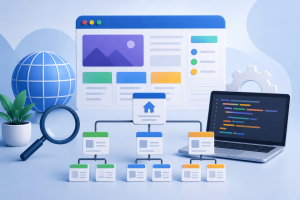
Search engines must be able to access your website before they can understand and rank your content. If they cannot reach your pages, those pages have little chance of appearing in search results, no matter how valuable the content is. Crawlability is one of the most important technical SEO concepts because it determines whether search engine bots can discover and read your website.
In this guide, you’ll learn what crawlability means, why it matters, what affects it, and how to identify and fix common issues that prevent search engines from crawling your site.
What Is Crawlability?
Crawlability refers to a search engine’s ability to access, navigate, and read the pages and resources on a website. Search engine crawlers, such as Googlebot, visit websites by following links, discovering new pages, and collecting information that may later be added to Google’s search index.
It’s important not to confuse crawlability with indexability.
- Crawlability determines whether a crawler can access a page.
- Indexability determines whether the page can be stored in a search engine’s index after it has been crawled.
A page must generally be both crawlable and indexable before it can appear in search results.
Although Google can occasionally index a URL without crawling its content, this is uncommon. In those cases, Google relies on the URL and anchor text from external links instead of the page’s actual content.
Why Crawlability Is Important for SEO
Search engines cannot rank content they cannot access. If a crawler is unable to reach a page, it cannot properly evaluate its content, understand its relevance, or determine whether it should appear in search results.
Good crawlability offers several SEO benefits:
- Helps search engines discover new pages quickly.
- Allows updated content to be recrawled faster.
- Improves the chances of pages being indexed.
- Prevents valuable content from remaining invisible to search engines.
- Supports better overall website performance in organic search.
Crawlability also matters beyond Google. SEO auditing tools and website crawlers rely on access to your pages to analyze technical SEO issues and monitor website health.
Factors That Affect Crawlability
Several technical factors determine whether search engines can successfully crawl your website.
1. Page Discoverability
Before a search engine can crawl a page, it must first discover that it exists.
Pages without internal links are known as orphan pages. Since nothing points to them, search engines may never find them.
Similarly, pages missing from your XML sitemap are harder for search engines to discover.
For the best results:
- Include important pages in your XML sitemap.
- Link to them through your site’s internal navigation.
- Avoid creating isolated pages with no internal links.
Using both internal linking and a sitemap provides multiple discovery paths for search engines.
2. Nofollow Links
Search engines generally do not follow links marked with the rel="nofollow" attribute.
If the only link pointing to a page is a nofollow link, search engine crawlers may never reach that page.
While nofollow links still have uses, they should not be relied upon for helping important pages get discovered.
3. Robots.txt Restrictions
The robots.txt file tells search engine crawlers which areas of a website they can or cannot access.
If a page is blocked within robots.txt, crawlers will usually not visit it.
For pages you want indexed:
- Ensure they are not blocked in robots.txt.
- Regularly review robots directives after website updates or migrations.
- Avoid accidentally blocking important folders or resources.
A single incorrect robots rule can prevent entire sections of a website from being crawled.
4. Access Restrictions
Some websites intentionally limit access to certain pages.
These restrictions may include:
- Login requirements
- Password-protected pages
- IP address restrictions
- User-agent blocking
- Firewall rules
If search engine bots cannot access the page because of these restrictions, they will not be able to crawl its content.
Common Crawlability Problems
Many technical SEO issues can reduce a website’s crawl efficiency.
Some of the most common include:
- Broken internal links
- Orphan pages
- Incorrect robots.txt rules
- Excessive redirect chains
- Server errors
- Login-protected content
- Blocked JavaScript or CSS resources
- Poor internal linking structure
Regular technical audits help identify these issues before they affect search visibility.
How to Check Crawlability Issues
The easiest way to detect crawling problems is by performing a technical SEO audit.
Most professional SEO auditing tools can:
- Crawl your entire website
- Identify blocked pages
- Find orphan pages
- Detect broken links
- Report robots.txt issues
- Monitor recurring technical problems
- Highlight crawl errors over time
These reports make it easier to understand why search engines may be struggling to access certain pages and which issues should be fixed first.
Regular website audits are especially important after redesigns, migrations, or large content updates.
Crawlability vs. Indexability
Although these terms are closely related, they describe different stages of the search engine process.
| Crawlability | Indexability |
|---|---|
| Determines whether search engines can access a page. | Determines whether the page can be stored in the search index. |
| Happens before indexing. | Happens after crawling. |
| Controlled by links, robots.txt, and access permissions. | Influenced by noindex tags, canonical tags, duplicate content, and page quality. |
A page may be crawlable but still not appear in search results if Google decides not to index it.
Can Google Index a Page Without Crawling It?
Yes—but only in rare situations.
If Google discovers a URL through backlinks or other public references, it may add the URL to its index without actually crawling the page.
When this happens:
- The URL may appear in search results.
- Google may use anchor text from external links.
- The page title and meta description may not appear correctly.
- The actual page content is not evaluated.
This usually occurs when crawling is blocked but the URL is still discoverable through other websites.
Best Practices to Improve Crawlability
Following a few technical SEO best practices can help search engines crawl your website more efficiently:
- Build a clear internal linking structure.
- Keep your XML sitemap updated.
- Remove orphan pages.
- Review robots.txt regularly.
- Avoid unnecessary nofollow links on important pages.
- Fix broken internal links and redirects.
- Ensure important content is publicly accessible.
- Monitor crawl errors through SEO auditing tools.
- Maintain a logical website architecture.
These practices make it easier for search engines to discover and process your content.
Conclusion
Crawlability is the foundation of successful technical SEO. If search engine bots cannot access your pages, they cannot evaluate, index, or rank them effectively. By maintaining strong internal linking, updating your sitemap, avoiding unnecessary crawl restrictions, and regularly auditing your website, you help search engines discover your content efficiently and maximize your chances of earning organic search traffic.
![What Is SEO? All You Need To Know [2022 Updated]](https://seogrowthengine.com/wp-content/uploads/2021/10/SEO-300x161.jpg)