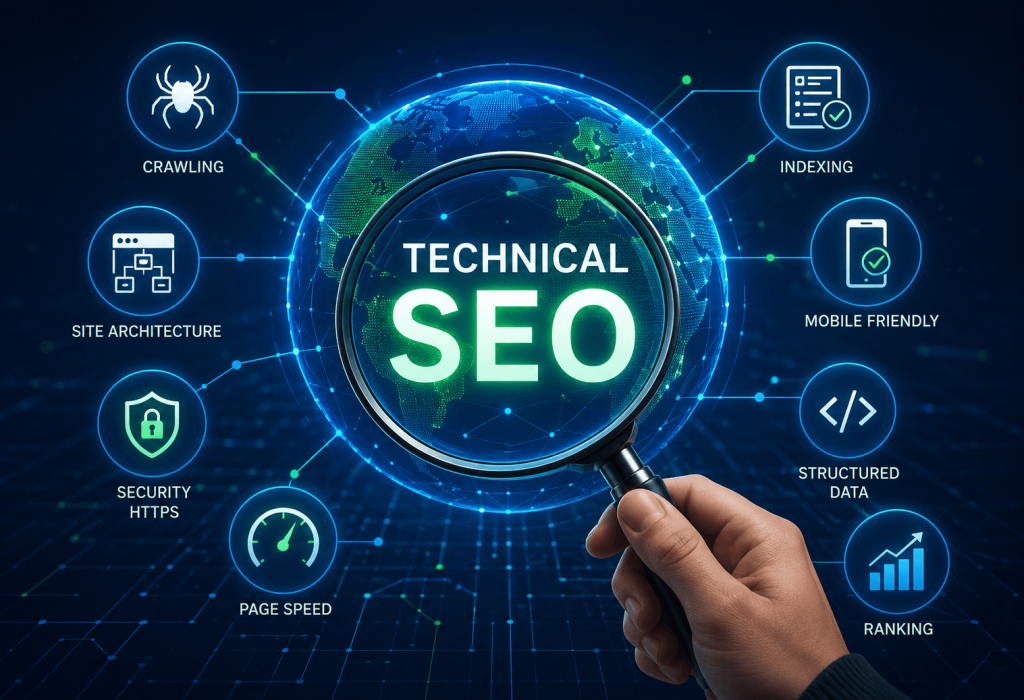
Search engines can only rank content they can discover, understand, and index. Even the most informative articles or valuable products may struggle to gain visibility if a website has technical issues preventing search engines from accessing its pages. That’s why technical SEO is an essential part of every successful SEO strategy.
As search continues to evolve with AI-powered platforms like ChatGPT, Google AI Overviews, Microsoft Copilot, and Gemini, technical optimization has become even more important. These systems rely on a website’s technical foundation to interpret content accurately and determine whether it deserves to appear in search results or AI-generated responses.
This guide explains the fundamentals of technical SEO, why it matters, and the best practices that help improve visibility across both traditional search engines and modern AI search experiences.
What Is Technical SEO?
Technical SEO focuses on optimizing the technical aspects of a website so search engines can efficiently crawl, render, understand, and index its pages.
Unlike content optimization, which improves what users read, technical SEO improves how search engines interact with your website behind the scenes. It ensures that important pages are accessible, load correctly, and provide the right signals for ranking.
A strong technical foundation also makes it easier for AI systems to identify reliable information and reference your content in AI-generated answers.
Why Technical SEO Matters
Technical SEO is the backbone of organic search performance. If search engines cannot access or interpret your pages properly, your content has little chance of ranking regardless of its quality.
Proper technical optimization helps:
- Improve crawling efficiency
- Increase indexation of important pages
- Strengthen website security
- Enhance user experience
- Support faster loading times
- Make content easier for AI systems to understand
- Improve overall search visibility
Without these fundamentals, valuable content often remains invisible.
Understanding Crawling
Crawling is the process search engines use to discover pages on the web. Automated bots follow links from one page to another, continually searching for new or updated content.
If search engine crawlers cannot find your pages, they cannot index or rank them.
Build a Logical Site Structure
An organized website helps both users and search engines navigate content efficiently.
A good structure usually follows this pattern:
- Homepage
- Category pages
- Subcategories
- Individual content pages
Keeping important pages within a few clicks of the homepage improves discoverability and reduces the chance of orphan pages.
Eliminate Orphan Pages
Orphan pages are webpages that have no internal links pointing to them.
Since search engines primarily discover new content through links, orphan pages often receive little or no visibility.
Regularly review your internal linking strategy and ensure every valuable page is connected to other relevant content.
Submit an XML Sitemap
An XML sitemap acts as a roadmap for search engines by listing your most important pages.
Although search engines can discover content through links, submitting a sitemap makes the discovery process faster and more reliable, especially for large websites or newly published content.
After creating your sitemap, submit it through Google Search Console.
Configure Robots.txt Correctly
The robots.txt file tells search engine bots which parts of your website they can or cannot crawl.
Review this file regularly to avoid accidentally blocking important content.
If your goal includes appearing in AI search platforms, ensure that AI crawlers capable of accessing public content are not unintentionally restricted.
Remember that blocking crawling is different from preventing indexing. If a page should never appear in search results, use a noindex directive instead.
Consider JavaScript Rendering
Modern websites often rely heavily on JavaScript to display content.
While Google can render JavaScript, many AI crawlers have limited rendering capabilities and primarily rely on the HTML they initially receive.
If essential content only appears after JavaScript executes, some search systems may never see it.
Important information, navigation, and internal links should always be accessible without depending entirely on client-side rendering.
Understanding Indexing
After discovering a page, search engines evaluate and store it in their index.
Only indexed pages are eligible to appear in search results.
A quick way to check whether Google has indexed your pages is by using the site: search operator.
If valuable pages remain unindexed, investigate possible technical issues.
Use Noindex Carefully
The noindex directive tells search engines not to include a page in search results.
It is useful for pages such as:
- Thank-you pages
- Login pages
- Internal search results
- Test environments
- Duplicate filtered URLs
Avoid placing noindex on pages you actually want to rank.
Implement Canonical Tags
Duplicate or highly similar pages can confuse search engines.
Canonical tags identify the preferred version of a page, helping consolidate ranking signals and reducing duplicate content problems.
Every group of similar pages should clearly indicate the primary URL.
Additional Technical SEO Best Practices
Secure Your Website with HTTPS
HTTPS encrypts communication between users and your website, protecting sensitive information.
Search engines also consider HTTPS a trust signal.
If your website still uses HTTP, migrate to HTTPS and redirect all HTTP URLs to their secure versions.
Prevent Duplicate Content
Duplicate content doesn’t always trigger penalties, but it can dilute rankings and waste crawl resources.
Common causes include:
- Multiple URL variations
- Printable versions
- Session parameters
- Category duplication
Use canonical tags, redirects, and proper URL management to reduce duplication.
Choose One Preferred Domain Version
Search engines should only access one version of your domain.
For example:
- https://example.com
- https://www.example.com
Allowing both versions to remain accessible creates duplicate content and divides link equity.
Redirect one version permanently to the other.
Improve Page Speed
Fast-loading websites provide a better experience and often perform better in search results.
Ways to improve speed include:
- Compressing images
- Enabling browser caching
- Minifying CSS and JavaScript
- Using a Content Delivery Network (CDN)
- Reducing unnecessary scripts
Regularly test your website with tools like PageSpeed Insights.
Optimize for Mobile Devices
Google primarily evaluates the mobile version of your website.
Your mobile pages should contain the same essential content, navigation, and structured data as the desktop version.
Responsive design, readable fonts, and properly spaced buttons all contribute to a better mobile experience.
Use Breadcrumb Navigation
Breadcrumbs improve navigation by showing users their location within a website.
Example:
Home → SEO → Technical SEO → Crawl Budget
Besides improving usability, breadcrumbs strengthen internal linking and help search engines understand your website hierarchy.
Implement Pagination Correctly
Large collections of products, blog posts, or articles often require pagination.
Proper pagination helps search engines discover additional pages while maintaining a clean browsing experience.
Avoid relying entirely on infinite scrolling, which may hide content from search engine crawlers.
Add Structured Data
Structured data, also called Schema markup, provides additional context about your content.
It helps search engines understand whether a page represents:
- Products
- Articles
- Recipes
- Events
- Organizations
- Reviews
- FAQs
Proper Schema implementation can increase eligibility for rich results while making your content easier for AI systems to interpret.
Always ensure structured data matches the visible information on the page.
Fix Broken Pages
Broken pages create poor user experiences and waste valuable backlinks.
If a page no longer exists, either:
- Restore it if it was removed accidentally.
- Redirect it to the most relevant replacement page.
Also update any internal links that still point to outdated URLs.
Optimize Core Web Vitals
Core Web Vitals measure important aspects of user experience.
The three primary metrics include:
- Largest Contentful Paint (LCP): Loading performance
- Interaction to Next Paint (INP): Responsiveness
- Cumulative Layout Shift (CLS): Visual stability
Improving these metrics contributes to better usability and stronger technical performance.
Use Hreflang for International Websites
If your website serves multiple languages or countries, implement hreflang tags.
These tags help search engines deliver the correct language version to each visitor while reducing duplicate content across international pages.
Monitor Technical SEO Regularly
Technical SEO requires continuous maintenance.
As websites grow, new issues naturally appear, including:
- Redirect chains
- Broken links
- Duplicate pages
- Crawl errors
- Missing metadata
- Slow-loading resources
Regular technical audits help identify problems before they negatively impact rankings.
Prepare for AI Search
Modern search extends beyond Google’s traditional results.
AI assistants increasingly evaluate websites before citing them in generated answers.
To improve your chances of appearing in AI-powered experiences:
- Maintain a clean site structure.
- Use descriptive metadata.
- Keep structured data accurate.
- Ensure content is crawlable.
- Use consistent terminology across headings, text, images, and Schema.
- Make page relationships clear through internal linking.
Consistency helps AI systems understand exactly what each page is about.
Conclusion
Technical SEO forms the foundation of every successful website. It ensures search engines can crawl, render, index, and understand your content while also improving user experience and website performance.
Rather than attempting to fix everything at once, begin with the essentials: crawlability, indexing, HTTPS, mobile optimization, and site speed. Then gradually improve areas such as structured data, Core Web Vitals, internal linking, and international SEO.
As AI-powered search continues to grow, maintaining a technically sound website will become even more valuable. Websites with strong technical foundations are better positioned to earn visibility, rank consistently, and appear in both traditional search results and AI-generated answers.