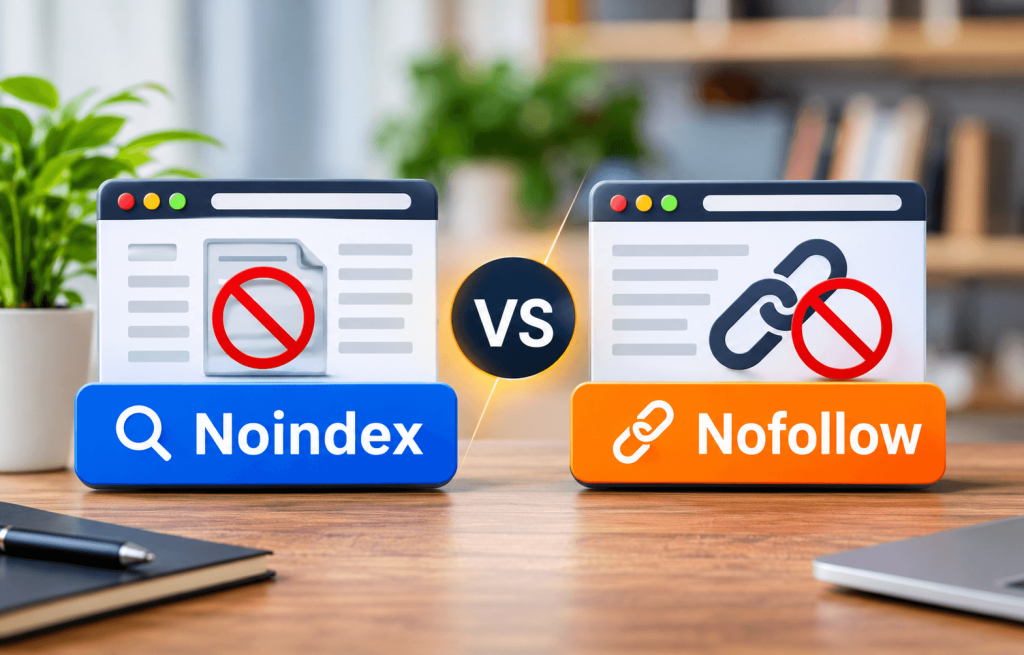





Understanding the difference between noindex and nofollow is an essential part of technical SEO. Although these directives are often mentioned together, they solve two very different problems. Noindex determines whether a page should appear in search results, while nofollow influences how search engines treat links.
Using either directive incorrectly can create unexpected SEO problems. A misplaced noindex instruction can remove valuable pages from search results, while unnecessary nofollow attributes can interfere with internal linking and the way authority moves through a website.
This guide explains how noindex and nofollow work, how search engines interpret them, how they affect crawling, indexing, internal links, PageRank, sitemaps, faceted navigation, JavaScript websites, e-commerce platforms, and AI-driven search. It also covers practical implementation methods, common mistakes, testing procedures, and situations where these directives should-or should not-be used.
Why Noindex vs Nofollow Still Confuses SEOs
Noindex and nofollow are two of the most commonly discussed technical SEO directives, yet they continue to cause confusion even among experienced website owners.
The basic explanation sounds straightforward: noindex controls indexing, while nofollow relates to links. The problem begins when these directives are applied to real websites containing thousands or millions of URLs, complicated navigation systems, dynamic filters, duplicate content, JavaScript-rendered pages, and multiple technical SEO signals.
A small implementation mistake can have consequences that remain unnoticed for weeks or months.
For example, a valuable category page might accidentally receive a noindex directive and disappear from search results. A CMS could add nofollow to internal navigation links across an entire website. A staging environment might launch with a global noindex instruction still active. Or a page could be blocked in robots.txt before a search engine gets the opportunity to process its noindex directive.
These problems happen because noindex and nofollow sit at the intersection of crawling, indexing, link discovery, and ranking signals.
The history of these directives also contributes to the confusion. In earlier SEO practices, nofollow was sometimes used as a method of PageRank sculpting. Search engine behavior has evolved considerably since then. Google changed its treatment of nofollow in 2019, moving from a strict directive model toward a hint-based approach.
Noindex is different. Its primary purpose remains preventing a page from appearing in search results once the directive has been discovered and processed.
Modern search engines also evaluate websites using much more sophisticated systems than simple rule-following crawlers. They consider site structure, context, internal links, content relationships, and many other signals when deciding how URLs should be handled.
Common implementation problems include:
- Important category pages accidentally marked noindex
- Filtered URLs using inappropriate directives
- Staging pages becoming accessible to search engines
- Internal navigation receiving unnecessary nofollow attributes
- Global robots directives being added through templates
- Noindex pages remaining unnecessarily present in XML sitemaps
- robots.txt rules preventing search engines from seeing noindex instructions
The directives themselves are not inherently complicated. The difficulty comes from understanding where they operate and how they interact with the rest of a website.
The best approach is therefore to understand the fundamentals first and then consider how these directives behave within larger technical SEO systems.
Quick Comparison Table: Noindex vs Nofollow at a Glance
The simplest way to understand the difference is to compare their primary purposes.
| Factor | Noindex | Nofollow |
| Primary function | Tells search engines not to include a page in search results | Tells search engines how to treat a particular link |
| Does it prevent crawling? | No. The page generally needs to be crawled so the directive can be discovered | No. A search engine may still crawl the link |
| Does it affect indexing? | Yes | No, not directly |
| Does it affect links? | It can influence how the page participates in the link graph | Primarily affects the treatment of the marked link |
| Type | Directive | Hint for Google |
| Common implementation | Meta robots tag or X-Robots-Tag | rel=”nofollow” or a robots meta directive |
| Typical uses | Thin pages, duplicate URLs, confirmation pages, staging content | Paid, untrusted, user-generated, or uncertain links |
| Main misuse risk | Removing valuable pages from search results | Creating unnecessary restrictions in the internal link structure |
The most important distinction is simple:
Noindex is about the page. Nofollow is about the link.
That distinction should guide almost every implementation decision.
What Is Noindex? Technical Definition & Search Engine Behavior
The noindex directive tells search engines that a particular page should not be included in their searchable index.
A common implementation uses a robots meta tag inside the HTML <head> section:
<meta name=”robots” content=”noindex, follow”>
The directive can also be communicated through an HTTP response header using X-Robots-Tag.
This second method is particularly useful when controlling the indexation of files that are not ordinary HTML pages, such as PDFs or other downloadable resources.
One technical detail is especially important: a search engine must generally be able to access the page before it can see and process a noindex directive.
If the URL is completely blocked by robots.txt, the crawler cannot retrieve the page and therefore cannot read the noindex instruction contained within it.
That can create an unexpected situation where a URL remains known to search engines through external links or other signals even though its content cannot be crawled.
How Search Engines Process Noindex
A simplified sequence looks like this:
- The search engine discovers the URL.
- The crawler requests the page.
- The page is rendered and processed.
- The crawler detects the noindex instruction.
- The indexing system excludes the URL from searchable results.
The removal process is not necessarily immediate.
A page may continue appearing temporarily after a noindex instruction is introduced. How quickly it disappears can depend on crawling frequency, site size, internal links, external references, and other signals.
Variations of Noindex
Noindex is commonly combined with other robots directives.
For example:
<meta name=”robots” content=”noindex, follow”>
or:
<meta name=”robots” content=”noindex, nofollow”>
These combinations communicate different intentions.
With noindex, follow, the page should not appear in search results, while its links can still be considered for crawling and link relationships.
With noindex, nofollow, the page is excluded from search results and its links receive a nofollow instruction as well.
For many low-value pages that still contain useful internal links, noindex, follow is generally the more logical configuration.
Using noindex, nofollow without considering the page’s role in the website architecture can unnecessarily isolate other pages.
Another common misunderstanding is that noindex automatically makes every link from that page worthless. Noindex primarily controls whether the page itself is included in search results. Search engines can still process links found on crawlable pages.
For detailed implementation rules, always check the current documentation provided by the relevant search engine because search behavior and supported directives can change.
What Is Nofollow? Technical Definition & Link Signal Treatment
Nofollow has a different purpose from noindex.
Instead of telling a search engine whether a page should appear in its index, nofollow provides information about how a particular link should be treated.
The attribute is commonly written as:
<a href=”https://example.com” rel=”nofollow”>Example</a>
Nofollow was originally introduced largely to help combat comment spam and control the treatment of links that publishers did not want to endorse.
Unlike noindex, which is usually page-level, a nofollow attribute is most commonly attached directly to an individual link.
A page-wide nofollow directive can also be specified through robots meta instructions, but that approach is less common.
From Directive to Hint
Google changed its treatment of nofollow in 2019.
Instead of treating nofollow as an absolute instruction that must always be obeyed, Google now treats it as a hint.
This means:
- Google may still crawl a nofollowed link.
- The link can potentially contribute signals in some circumstances.
- Search systems can use additional context when deciding how to interpret the link.
This change made traditional PageRank sculpting strategies much less dependable.
Using nofollow across internal links simply to try to force authority toward selected pages is not a reliable modern SEO strategy.
Related Link Attributes
Search engines also provide more specific attributes for different types of links.
These include:
rel=”ugc”
for user-generated content, and:
rel=”sponsored”
for paid or sponsored links.
These attributes provide context about why the link exists instead of treating every non-editorial link in exactly the same way.
How Nofollow Impacts Link Equity
When used appropriately, nofollow can help:
- Identify links that should not be treated as editorial endorsements
- Reduce the risk of passing signals to untrusted destinations
- Clarify the nature of paid or user-generated links
- Establish boundaries around links that require additional qualification
However, excessive use of nofollow within a website’s own navigation can create architectural problems.
For example, if a CMS automatically applies nofollow to navigation menus, breadcrumbs, category links, or contextual internal links, important pages may receive weaker or more ambiguous internal signals.
The goal should not be to prevent links from carrying value simply because they are links. Instead, the attribute should communicate genuine editorial or commercial intent.
How Google Interprets Noindex and Nofollow
Understanding the distinction becomes easier when viewed through the general search process.
A simplified search engine workflow contains four broad stages:
- Crawl
- Render
- Index
- Rank
Noindex primarily affects the indexing stage.
Once Google discovers and processes a valid noindex instruction, the URL should be excluded from search results.
Nofollow operates more directly around the evaluation of links between crawling, discovery, and ranking.
Because Google treats nofollow as a hint, its effect is not equivalent to a guaranteed wall around the link.
Directive vs Hint
The practical difference is:
- Noindex: a directive intended to prevent the page from being indexed.
- Nofollow: a hint about how a link should be treated.
This distinction is important when designing internal linking systems.
Using nofollow to control the distribution of internal authority is no longer a dependable method of PageRank sculpting.
Crawl Budget Implications
Noindex does not automatically stop crawling.
A noindexed page can continue to be crawled if it remains accessible through internal links, sitemaps, external references, or other discovery mechanisms.
This matters most on large websites.
Nofollow also should not be viewed as a guaranteed crawl-budget solution. Search engines can still discover or crawl a URL associated with a nofollowed link.
For large websites, decisions about crawl efficiency should therefore consider:
- Internal link architecture
- URL discovery patterns
- XML sitemap configuration
- External links
- Parameter handling
- Faceted navigation
- Server behavior
- Crawl frequency
Directives are only one part of the overall crawl-management strategy.
Noindex vs Nofollow: Core Differences Explained Through Crawling & Indexing
Definitions become much clearer when the two directives are mapped onto the way search engines process URLs.
Imagine the following simplified sequence:
Step 1: Discovery
A URL can be discovered through:
- Internal links
- XML sitemaps
- External backlinks
- Other known URLs
- Search engine systems
Step 2: Crawling
The crawler requests the URL and retrieves its available resources.
Step 3: Rendering
The search engine processes the HTML and, where necessary, executes JavaScript to understand the page.
Step 4: Indexing Decision
The search engine determines whether the page should be stored and made eligible for search results.
Step 5: Link Processing
Links found on the page are evaluated and incorporated into the search engine’s understanding of the site’s link graph.
The two directives operate differently within this process.
Where Noindex Operates
Noindex becomes relevant after the crawler can access and process the page.
A simplified sequence is:
- The URL is discovered.
- The page is crawled.
- The directive is detected.
- The indexing system excludes the URL.
The page does not disappear from the crawl ecosystem simply because it is excluded from search results.
It can still be requested again. It can still contain links. Also, it can still be part of the broader URL graph.
The critical distinction is that noindex controls search visibility, not whether the URL exists or can be crawled.
Where Nofollow Operates
Nofollow is associated with link handling.
The page itself can remain indexable. The nofollow instruction instead communicates how the search engine should treat a particular outgoing link.
Because Google treats nofollow as a hint, it should not be described as an absolute instruction to block all link-related signals.
This gives us the simplest technical comparison:
- Noindex controls whether a page can appear in search results.
- Nofollow influences how a link is treated.
They solve different problems and should not be used interchangeably.
How Noindex Impacts Technical SEO Signals
Noindex looks like a simple indexing instruction, but its effects can extend into several areas of technical SEO.
Crawl Budget
Noindex does not prevent a crawler from visiting the URL.
If the URL remains prominent in the site’s internal architecture or appears in XML sitemaps, it may continue receiving crawl attention.
This can become significant on websites with tens or hundreds of thousands of URLs.
E-commerce websites are particularly vulnerable because filters, sorting options, combinations, and parameters can generate huge numbers of URLs.
If thousands of these pages are noindexed but remain widely linked, crawlers may still spend substantial resources requesting them.
Crawl behavior can be influenced by factors such as:
- Internal link prominence
- Previous crawl history
- External backlinks
- Sitemap inclusion
- Server performance
- URL discovery patterns
Therefore, if the actual objective is reducing crawling, noindex by itself is not enough.
Internal Link Equity
Another frequently misunderstood issue is whether links from noindexed pages can still matter.
A noindex instruction removes the page from search results. It does not automatically erase the page from the crawl graph.
Search engines can still process links on accessible pages.
This means a page can be excluded from the index while still contributing to the site’s broader linking relationships.
However, this should not be interpreted as a reason to create large numbers of noindexed pages and expect them to function indefinitely as authority hubs.
If a page remains excluded, receives little external attention, and loses crawl priority, its practical influence can decline.
A useful strategy is:
- Use noindex for utility pages that should remain accessible but should not rank.
- Avoid accidentally noindexing important category, topic, or commercial pages.
- Review the role of every page before applying the directive.
PageRank Flow and the Sculpting Myth
PageRank sculpting through noindex and nofollow has a long history in SEO.
Older strategies attempted to concentrate authority by restricting certain links or excluding pages that were considered less important.
Modern search engines are considerably more sophisticated, and this approach should not be treated as a reliable authority-distribution technique.
A noindexed page does not simply disappear from the site’s link relationships.
Likewise, nofollowed links do not automatically cause the value that would have gone through them to be redistributed proportionally to other links.
Effective internal authority management is better achieved through:
- Clear information architecture
- Logical navigation
- Strong contextual links
- Relevant category structures
- Useful content relationships
- Intentional URL design
Sitemap Inclusion Strategy
Including a permanently noindexed URL in an XML sitemap creates conflicting signals.
A sitemap generally communicates that a URL is an important page that search engines should discover and potentially index.
Noindex communicates the opposite.
For permanently excluded URLs, a cleaner approach is generally to remove them from the XML sitemap.
Temporarily noindexed pages may remain in a sitemap when there is a legitimate plan to make them indexable again, but this should be handled intentionally.
A consistent sitemap helps search engines understand which URLs represent the site’s preferred indexable content.
How Nofollow Impacts Link Architecture
Nofollow is primarily concerned with links rather than the indexation status of the page containing them.
External Links
One of the most common situations for qualifying external links is when the destination is paid, sponsored, user-generated, or otherwise not a normal editorial recommendation.
Common attributes include:
rel=”sponsored”
for paid placements,
rel=”ugc”
for user-generated content,
and:
rel=”nofollow”
when you want to communicate that the link should not be treated as a normal editorial endorsement.
The correct attribute depends on the relationship between the publisher and the destination.
Using these attributes thoughtfully provides search engines with additional context.
Internal Links
Internal nofollow deserves considerably more caution.
Navigation menus, breadcrumbs, contextual links, category pages, product links, and other internal relationships form the structure search engines use to understand a website.
Applying nofollow to these connections without a strong reason can introduce unnecessary ambiguity.
If a page is important enough to feature prominently in your internal architecture, it will usually make more sense to allow search engines to evaluate that relationship normally.
Rather than asking:
“Which internal links should I nofollow?”
A better question is often:
“Should this internal link exist at all?”
If a page is genuinely unnecessary, reducing unnecessary linking may be cleaner than keeping the link and attempting to suppress its signals.
Link Equity Distribution
A persistent SEO myth is that nofollow allows you to preserve or redistribute the authority that would otherwise have gone through a particular link.
That is not a reliable way to think about modern link evaluation.
Search engines do not simply take the “blocked” value from a nofollowed link and divide it among the remaining links.
Instead, the nofollowed relationship is evaluated according to the search engine’s systems and surrounding context.
Overusing nofollow can therefore create unnecessary complexity without producing the desired authority concentration.
Spam & UGC Management
Nofollow and rel=”ugc” can be useful for:
- Blog comments
- Community forums
- User-submitted profiles
- Public discussion areas
- Other forms of user-generated content
They can help communicate that the website does not necessarily editorially endorse every external destination submitted by users.
These attributes can:
- Reduce the risk of unintentionally endorsing spam destinations
- Clarify the nature of user-submitted links
- Establish a distinction between editorial and non-editorial content
However, blanket policies should be reviewed carefully.
A website that automatically nofollows every link submitted by users may be missing opportunities to recognize legitimate, moderated contributions.
Noindex + Nofollow Together: When and When Not to Combine Them
It is technically possible to use noindex and nofollow together:
<meta name=”robots” content=”noindex, nofollow”>
This combination communicates two separate instructions:
- Do not include the page in search results.
- Do not treat its links as normal followed links.
There are situations where this combination can make sense, including:
- Staging environments
- Internal administration areas
- Temporary technical endpoints
- Certain duplicate or isolated utility pages
- Private internal tools
However, it should not automatically be applied to every page that does not need to rank.
For many public pages that have useful internal links, the following can be more appropriate:
<meta name=”robots” content=”noindex, follow”>
This keeps the page out of search results while allowing its links to remain part of the site’s crawl and link structure.
Applying noindex, nofollow broadly to navigation or structural pages can isolate important sections of a website.
This is especially dangerous when the directive is introduced globally through a CMS template.
Meta Robots vs X-Robots-Tag: Implementation Differences
There are two major ways to implement noindex.
Meta Robots Tag
The HTML version appears inside the <head>:
<meta name=”robots” content=”noindex, follow”>
Advantages include:
- Easy CMS implementation
- Straightforward template management
- Simple page-level control
- Compatibility with standard HTML documents
The limitation is that search engines must retrieve and process the HTML to discover the instruction.
X-Robots-Tag
The server can communicate the directive through an HTTP header:
X-Robots-Tag: noindex
This is particularly useful when controlling:
- PDFs
- Images
- Videos
- Downloadable files
- API responses
- Dynamic endpoints
- Large groups of URLs
Server-level rules can also be easier to scale across enterprise websites.
For example, a server or CDN could apply a noindex header to an entire URL pattern without requiring developers to modify each HTML template.
Another difference is visibility.
A meta robots tag can usually be found by viewing the page source. An X-Robots-Tag requires inspection of the HTTP response headers.
During technical audits, both layers should be checked.
Noindex in HTTP Headers vs HTML Meta Tags
The underlying purpose is the same, but the delivery mechanism is different.
There are two primary options:
- HTML meta robots
- HTTP X-Robots-Tag
Both can communicate noindex, but they operate at different levels.
HTML Meta Robots Tag
The standard implementation is:
<meta name=”robots” content=”noindex, follow”>
This works well for:
- Blog posts
- Landing pages
- Product pages
- Category pages
- Standard HTML documents
The major limitation is that the page must be crawled and processed before the search engine can detect the directive.
JavaScript-heavy websites can introduce additional complications.
If the noindex instruction is inserted dynamically after the initial HTML response, rendering behavior becomes important.
A directive that appears too late or fails to render correctly can produce unexpected indexing behavior.
X-Robots-Tag in HTTP Headers
The server-side version is:
X-Robots-Tag: noindex
Because the instruction is delivered through the HTTP response, it does not depend on an HTML meta element.
It can therefore be applied to:
- PDF documents
- Images
- Video files
- API responses
- Dynamic resources
- Non-HTML endpoints
This makes X-Robots-Tag particularly useful for large websites with rule-based index management.
For example, a server can apply noindex to URLs matching a particular parameter pattern.
From an auditing perspective, inspect:
- The HTML source
- Rendered HTML where relevant
- HTTP response headers
If different systems provide contradictory directives, investigate the source of the conflict rather than assuming the implementation is correct.
How Noindex Interacts with Other Technical SEO Signals
Noindex rarely exists by itself.
It often interacts with canonical tags, hreflang, pagination, faceted navigation, and URL parameters.
These signals should be evaluated together.
Noindex and Canonical Tags
A canonical tag tells search engines which URL should be treated as the preferred version among similar or duplicate URLs.
Noindex has a different purpose: it tells search engines not to include the page itself in search results.
Using both can create complicated signals.
For example, a page could contain:
- A noindex directive
- A canonical pointing to another URL
Search engines may process the noindex instruction while also evaluating the canonical relationship.
If the page has a self-referencing canonical and noindex, the signals are particularly contradictory.
You are effectively communicating:
“This is the preferred version.”
while also saying:
“Do not include this page in the index.”
When the goal is consolidation, canonicalization is generally the more appropriate mechanism.
When the goal is exclusion, noindex is usually the clearer signal.
Noindex and Hreflang
Hreflang connects alternate versions of pages for different languages or regions.
For an international page set to function correctly, the relevant pages generally need to be indexable.
If one page in an hreflang relationship is noindexed, the overall relationship can become less useful.
A common problem occurs during website development when alternate language versions are temporarily marked noindex and the directive remains active after launch.
If a localized page is intended to appear in search results for its target audience, it should not accidentally remain noindexed.
Noindex and Pagination
Pagination can create difficult technical SEO decisions.
For example, a category could contain:
- Page 1
- Page 2
- Page 3
- Page 4
- And so on
Noindexing deeper pages may remove them from search results, but those pages can still be valuable for discovering products or content.
Potential consequences include:
- Reduced search visibility for deeper pages
- Weaker product discovery pathways
- Changes in crawl behavior
Selective noindexing can make sense for genuinely thin archives, but applying it automatically to every paginated page can cause unnecessary problems.
The key question is whether those pages provide independent value or simply duplicate other URLs.
Noindex and Faceted Navigation
Faceted navigation can generate enormous numbers of URL combinations.
For example, a store might create combinations for:
- Brand
- Size
- Color
- Price
- Material
- Availability
Noindex can help control index bloat, but it does not automatically solve the underlying crawling problem.
Search engines may continue crawling those URLs if they remain accessible through internal links.
For large e-commerce sites, a stronger strategy may combine:
- Controlled internal linking
- Canonicalization
- Parameter management
- Selective noindex
- Careful sitemap configuration
The exact combination should depend on the site’s search demand and URL architecture.
Noindex and Parameter URLs
URL parameters frequently create near-duplicate versions.
Examples include:
?sort=price
?filter=color
?session=123
Some parameter variations may be useful, while others add no meaningful content.
Selective noindex can be appropriate for certain combinations, but canonicalization or architectural changes may be better when the variations represent essentially the same content.
Using noindex as a universal solution for every parameter URL can hide deeper problems with navigation and URL generation.
Noindex vs Disallow in robots.txt
One of the most important distinctions in technical SEO is the difference between noindex and robots.txt disallow.
They do not perform the same function.
A robots.txt rule such as:
User-agent: *
Disallow: /private-page/
tells crawlers not to access that URL.
It does not guarantee that the URL will be removed from search results.
If external links point to the blocked URL, a search engine may still know that the URL exists and potentially show it in search without being able to retrieve its content.
Noindex works differently.
A noindex directive tells the search engine not to include the page in its index, but the crawler generally needs access to the page to see that instruction.
This creates an important rule:
Do not block a page in robots.txt if you need the crawler to see its noindex directive.
A common sequence is:
- Allow the page to be crawled.
- Let the crawler discover noindex.
- Allow the URL to be removed from the index.
- Only then consider whether crawl blocking is still necessary.
Combining robots.txt disallow and noindex without understanding this sequence can lead to persistent indexation problems.
When to Use Noindex
Noindex should be used intentionally.
The goal is not simply to reduce the number of indexed URLs. The objective is to ensure that search engines focus on pages that genuinely deserve search visibility.
Common use cases include:
Thank-You and Confirmation Pages
Pages shown after form submissions or transactions usually have little independent search value.
Internal Search Results
Internal search-result pages can generate large numbers of low-value combinations and are generally not pages you want indexed.
Thin Tag Archives
If a tag archive contains little unique value and creates another low-quality URL, selective noindex may be appropriate.
Low-Value Filtered Pages
Some filter combinations do not provide meaningful content or search demand and may be better excluded.
Staging and Development Pages
Pre-launch pages should not accidentally become searchable.
Outdated Promotional Pages
A page may still need to remain accessible for users or historical reasons while no longer being appropriate for organic search.
The underlying principle is:
If a page does not deserve to rank independently but still has a legitimate user or technical purpose, noindex may be appropriate.
However, if hundreds or thousands of pages require noindex, investigate whether the underlying site architecture is creating unnecessary URLs.
When to Use Nofollow
Nofollow should primarily communicate link intent.
Appropriate situations can include:
Paid or Sponsored Links
For paid placements, rel=”sponsored” is generally the more specific attribute.
User-Generated Content
Comments, forum posts, and community contributions may use rel=”ugc” or nofollow depending on the circumstances.
Untrusted External Links
If you cannot confidently vouch for an external destination, nofollow can communicate that the link is not intended as a normal editorial endorsement.
Affiliate Links
Commercial relationships can be appropriately qualified using sponsored or nofollow attributes.
Uncertain Outbound References
In cases where you do not want to present an external link as a standard editorial recommendation, nofollow can provide an additional signal.
What should generally be avoided is applying nofollow broadly to important internal links.
When You Should NOT Use Either
Sometimes the best technical SEO decision is to leave the directives alone.
Not every weak page requires noindex.
Not every external link requires nofollow.
Overuse can make a site harder for search engines to interpret.
Avoid Noindex on Pages That:
- Function as primary category hubs
- Support internal authority distribution
- Target important commercial keywords
- Form part of a strong topical content cluster
- Provide meaningful search demand
- Act as important entry points for users
Removing important pages from the index can weaken the overall topical structure of a website.
Avoid Nofollow on:
- Main internal navigation
- Breadcrumbs
- Contextual internal links
- Important category links
- Relevant editorial references
- Internal links between closely related content
Internal links do more than help users navigate.
They help search engines understand which pages are related and how different topics fit together.
The broader principle is simple:
Use directives to solve specific problems, not to compensate for unclear architecture.
If a website needs thousands of noindex or nofollow rules, the underlying issue may be its URL structure, taxonomy, navigation, or content strategy.
Enterprise SEO Use Cases
At enterprise scale, noindex and nofollow become part of larger systems rather than isolated page-level decisions.
Large websites can contain:
- Millions of URLs
- Dynamic filters
- Search results
- Regional versions
- Account areas
- API-generated pages
- Parameter variations
- Personalized experiences
Managing these URLs manually is unrealistic.
Large-Scale Index Management
Enterprise websites often create large quantities of low-value URLs through filters, sorting, search parameters, and other dynamic systems.
Server-level X-Robots-Tag rules can provide scalable control.
For example, rules can be designed to:
- Apply noindex to certain parameter combinations
- Exclude internal dashboard URLs
- Prevent search-result permutations from appearing in search
- Control large groups of non-HTML resources
However, index management should always be paired with crawl analysis.
A URL can be noindexed and still consume crawl resources if the site’s internal structure continues exposing it.
Governance and Risk Management
Enterprise SEO also requires strong deployment controls.
A single global noindex directive can potentially affect thousands or millions of URLs.
This makes deployment validation extremely important.
Useful safeguards include:
- Pre-launch technical checks
- Template validation
- Automated monitoring
- Index coverage tracking
- Deployment alerts
- Version-controlled directive rules
Development and SEO teams should understand exactly where robots directives are generated.
E-Commerce Specific Applications
E-commerce websites present some of the most complicated noindex and nofollow scenarios.
Filters, variants, seasonal products, sorting options, and faceted navigation can create enormous numbers of URLs.
Product Variations and Filters
A category page might generate combinations based on:
- Size
- Color
- Price
- Brand
- Material
- Sorting
Indexing every possible combination can produce index bloat.
But noindexing every combination can be equally problematic if some filtered pages match genuine search demand.
The correct approach is to evaluate search intent and page value.
A filtered page that satisfies a meaningful search query may deserve to be indexable.
A combination that creates little unique value may be better handled through noindex, canonicalization, or URL architecture changes.
Out-of-Stock Products
Out-of-stock products should not automatically be noindexed.
A discontinued or unavailable product may still have:
- Backlinks
- Search demand
- Historical rankings
- Product information
- Alternative product opportunities
Removing the page immediately can waste accumulated authority.
If the product is temporarily unavailable, keeping the page accessible can often be more useful.
Noindex is more appropriate when the page has permanently lost its value and there is no useful reason for it to remain searchable.
Affiliate and Marketplace Links
E-commerce websites often contain links to:
- Marketplaces
- Payment services
- Affiliate partners
- External retailers
Commercial links can be qualified using rel=”sponsored” or rel=”nofollow” where appropriate.
Internal product-to-category relationships are different.
Those links form the site’s commercial architecture and generally should not be nofollowed without a specific technical reason.
JavaScript SEO & Rendering Considerations
JavaScript has added another layer of complexity to technical SEO.
Search engines may need to:
- Retrieve the initial HTML.
- Render JavaScript.
- Process dynamically generated content.
- Interpret robots directives.
If a noindex directive is added only after client-side JavaScript executes, detection may depend on successful rendering.
This can create problems when:
- Rendering fails
- Hydration is delayed
- JavaScript changes the <head>
- A framework generates directives inconsistently
- Different versions of a page are served to different crawlers
For JavaScript-heavy websites, it is safer to expose critical SEO directives as early and reliably as possible.
Where practical:
- Include noindex in server-rendered HTML
- Avoid unnecessary client-side injection
- Test rendered output
- Verify the final HTML seen by crawlers
Dynamic Rendering and Edge Cases
Websites using dynamic rendering, edge functions, CDNs, or user-agent-specific logic should pay particular attention to consistency.
A page that returns one robots directive to one crawler and a different directive elsewhere can create confusing signals.
Technical validation should therefore include:
- Raw HTML
- Rendered HTML
- HTTP response headers
Testing only one layer may miss a directive generated somewhere else in the delivery stack.
How AI Search Engines Interpret Noindex & Nofollow
Search has expanded beyond traditional blue-link search results.
AI-powered search experiences can use indexed pages, structured information, entities, content relationships, and other signals to generate answers.
This makes indexation increasingly important for visibility across different search experiences.
A page that is deliberately excluded from search indexes is generally less likely to be available as a source for search systems that rely on indexed content.
This means noindex can influence more than conventional SERP visibility.
It may also affect a page’s potential presence in:
- AI-generated summaries
- Conversational search
- Search answer systems
- Other indexed-content discovery experiences
Nofollow is different.
Because it is treated as a hint, its effect on link signals is not necessarily absolute.
AI-driven search also places considerable importance on:
- Clear content
- Strong topical relationships
- Entity understanding
- Structured information
- Consistent internal architecture
Excessive internal nofollow can therefore make a site’s topical relationships less explicit.
The broader principle remains the same: a clean, understandable website structure is more useful than excessive use of technical restrictions.
Common Implementation Mistakes That Can Hurt Rankings
Many SEO problems involving noindex and nofollow are not caused by search engine penalties.
They are caused by implementation mistakes.
Accidental Global Noindex
One of the most serious errors occurs when a staging environment uses a global noindex directive and that setting is carried into production.
The result can be widespread deindexation.
A website may suddenly lose visibility across:
- Category pages
- Product pages
- Blog posts
- Landing pages
- Other important URLs
Deployment checks should therefore verify robots directives before and after launch.
Blocking a Noindexed Page in robots.txt
Another common error is adding a robots.txt disallow rule to a page that also contains noindex.
The crawler cannot retrieve the page, so it cannot see the noindex directive.
This can leave the URL known to search engines while preventing them from confirming the page’s indexing status.
Unnecessary Internal Nofollow
CMS settings or plugins can sometimes add nofollow to internal links unintentionally.
This can affect:
- Navigation
- Breadcrumbs
- Category links
- Contextual content links
- Product relationships
Internal links should be reviewed as part of technical audits.
Self-Canonical + Noindex
A page that declares itself canonical while simultaneously saying “do not index me” sends contradictory signals.
If the page is not intended to rank, the technical configuration should reflect that intention clearly.
Conflicting Header Directives
A page may contain a meta tag saying one thing while the HTTP response header says another.
For example:
<meta name=”robots” content=”index, follow”>
while the server sends:
X-Robots-Tag: noindex
These conflicts need to be investigated.
JavaScript-Injected Directives
If the noindex tag is inserted dynamically and rendering fails, the search engine may not process the intended instruction.
JavaScript SEO testing is therefore essential for modern frameworks.
The common theme behind these errors is that robots directives should not be treated as isolated checkboxes.
They need coordination between:
- SEO teams
- Developers
- Content teams
- CMS administrators
- Infrastructure teams
Testing & Validation Checklist
Never assume a robots directive is working simply because someone added a setting in a CMS.
Every important directive should be validated.
Step 1: Inspect the HTML
Check the page source for the expected meta robots tag.
For example:
<meta name=”robots” content=”noindex, follow”>
Confirm that the syntax is correct.
Step 2: Check HTTP Headers
Inspect the response headers for:
X-Robots-Tag
Look for conflicting instructions.
Step 3: Test Search Engine Interpretation
Use available URL inspection and indexing tools to determine:
- Whether the page can be crawled
- Whether noindex is detected
- Whether the page is currently indexed
- Whether indexing is allowed
- Whether another directive is creating a conflict
Step 4: Review Crawl Behavior
Log analysis can reveal whether noindexed URLs continue to consume significant crawl resources.
If they do, investigate:
- Internal links
- Sitemaps
- External references
- URL generation
- Navigation
- Parameters
Step 5: Audit Internal Nofollow
Review templates and navigation systems to make sure nofollow has not been added to important internal links unintentionally.
Step 6: Check Multiple Rendering Layers
For JavaScript websites, inspect:
- Initial HTML
- Rendered HTML
- HTTP response headers
All three should communicate the intended SEO behavior.
Step-by-Step Implementation Guide
The exact implementation depends on the platform, but the underlying SEO strategy remains the same.
WordPress
WordPress websites often manage noindex settings through SEO plugins, themes, or custom templates.
For an individual page, verify that the chosen setting generates an appropriate robots directive such as:
<meta name=”robots” content=”noindex, follow”>
After making the change:
- Confirm the correct setting in the CMS.
- Clear caching systems.
- Inspect the page source.
- Validate the URL through search engine tools.
- Remove permanently noindexed URLs from the XML sitemap.
For nofollow, apply the appropriate rel attribute to individual outbound links.
Avoid global configurations that automatically add nofollow to internal links unless there is a very specific reason.
Shopify
Shopify websites can require theme-level changes for more advanced index management.
Depending on the URL type, implementation may involve:
- Theme templates
- theme.liquid
- Collection templates
- Conditional meta tags
- Carefully selected apps
Filtered collection URLs should be evaluated individually rather than automatically receiving noindex.
Some variations may have meaningful search value, while others may be better consolidated or excluded.
External affiliate links can be appropriately qualified using rel=”sponsored” or rel=”nofollow”.
Custom CMS or Enterprise Platforms
Custom systems often provide more flexibility.
For large-scale URL patterns, X-Robots-Tag rules can be implemented at the server or CDN level.
A structured implementation process is:
- Identify the URL patterns requiring control.
- Determine whether indexation or crawling is the actual problem.
- Select meta robots or X-Robots-Tag based on the resource type.
- Implement the rule.
- Validate the response.
- Monitor indexing and crawling afterward.
Enterprise implementations should be documented and version-controlled so that technical SEO rules do not disappear during future deployments.
Real-World Examples
The following scenarios demonstrate how noindex and nofollow decisions can affect larger websites.
Example 1: Faceted Navigation Cleanup
Consider an e-commerce website with hundreds of thousands of generated URLs.
Thousands of filtered combinations have been indexed, many of which contain little unique content.
Instead of simply blocking everything in robots.txt, a more controlled strategy can include:
- Identifying low-value parameter combinations
- Applying selective noindex rules
- Improving internal linking
- Removing permanently noindexed URLs from sitemaps
- Monitoring crawl behavior
Over time, crawl attention can shift toward more important category and product URLs.
The key lesson is that index management should be based on URL value and architecture rather than blanket blocking.
Example 2: Accidental Global Noindex
Imagine a SaaS website undergoing a redesign.
During development, the entire staging website is marked noindex.
The redesign launches, but the global directive remains active.
Important pages begin disappearing from search results.
Once the directive is removed and the affected URLs are made available for indexing again, recovery can begin.
However, recovery is not necessarily instantaneous.
Crawl frequency differs from page to page, so highly important URLs may be processed before deeper pages.
The lesson is straightforward: production deployments should always include robots directive checks.
Example 3: Internal Nofollow Overuse
Consider a content website where a plugin automatically adds nofollow to internal cross-links.
Over time, important articles and category pages receive fewer clean internal linking signals.
Removing the unnecessary internal nofollow attributes restores a more straightforward linking structure.
The improvement may not appear overnight, but the site’s architecture becomes easier for search engines to understand.
A Technical Framework for Choosing the Right Directive
Choosing between index, noindex, follow, and nofollow should begin with the purpose of the URL and the link.
Question 1: Should the Page Appear in Search Results?
If yes, do not apply noindex.
If no, continue to the next question.
Question 2: Does the Page Still Have Architectural Value?
If the page contains useful internal links or helps users navigate the website, consider:
<meta name=”robots” content=”noindex, follow”>
If the page is purely functional and does not need to contribute to the site’s link structure, a noindex/nofollow combination may sometimes be appropriate.
Question 3: What Type of Outbound Link Is It?
For paid content:
rel=”sponsored”
For user-generated content:
rel=”ugc”
For an untrusted or uncertain destination:
rel=”nofollow”
For a normal editorially selected link, unnecessary restrictions are generally best avoided.
Question 4: Is the Real Problem Crawling?
If your concern is crawl waste rather than indexation, noindex may not solve the underlying issue.
Investigate:
- Internal linking
- URL generation
- Parameters
- Faceted navigation
- Sitemap configuration
- Crawl paths
A structural solution is often better than repeatedly suppressing URLs after they have already been discovered.
FAQs
Can Google index a page that has a noindex tag?
A crawlable page can remain temporarily visible in the index after noindex is introduced. Once Google processes the directive, the page should be removed from search results.
How long does it take for a noindexed page to disappear from search results?
There is no fixed timeframe. It can take days or potentially several weeks depending on how frequently the page is crawled and the site’s overall signals.
Does noindex stop a page from passing link equity internally?
Noindex primarily removes the page from search results. It does not automatically prevent search engines from processing links found on that page.
Does nofollow prevent Google from crawling a link?
Not necessarily. Google treats nofollow as a hint, so it may still crawl a nofollowed URL when other signals indicate that the URL should be discovered.
Should I noindex paginated pages?
Not automatically. If paginated pages provide useful product or content discovery, keeping them accessible and indexable may be beneficial. Noindex should be considered when those pages have little independent value.
Can I use canonical and noindex together?
Yes, but the combination should have a clear purpose. A self-canonical page that is also noindexed sends conflicting signals. If consolidation is the objective, canonicalization is generally more appropriate; if exclusion is the objective, noindex is clearer.
Is it better to use noindex or disallow in robots.txt for removing pages?
Noindex is generally the more direct method for telling search engines that a page should not appear in search results. Robots.txt disallow controls crawling and does not guarantee removal from the index.
Should internal links ever use nofollow?
There are specific situations where it can be justified, but in most cases important internal links should not be nofollowed unnecessarily. A clean internal linking structure helps search engines understand relationships between pages.
Do AI search engines access noindexed pages?
A page that is excluded from search indexes is generally less likely to be included in systems that rely on indexed content for generating search answers and summaries.
Does nofollow protect my site from penalties?
Nofollow and other link attributes can communicate that certain links are not normal editorial endorsements, particularly for paid, sponsored, or user-generated links. However, nofollow is not a substitute for maintaining high-quality content, responsible linking practices, and sound website architecture.
Final Thoughts
Noindex and nofollow may look like small technical settings, but they can influence important parts of a website’s search visibility and architecture.
The most important distinction is easy to remember:
Noindex controls whether a page should appear in search results. Nofollow influences how a link should be treated.
Noindex does not automatically stop crawling. Nofollow does not guarantee that a link will never be crawled. Robots.txt does not perform the same job as noindex. And neither directive should be used as a shortcut for fixing poor site architecture.
The best technical SEO strategies use these directives selectively.
Before adding noindex, determine whether the page genuinely needs to stay out of search results.
Before adding nofollow, determine whether there is a legitimate reason to qualify the link.
And before applying either directive at scale, understand how the change will affect crawling, indexing, internal linking, sitemaps, JavaScript rendering, and the broader structure of the website.
When these instructions are implemented with clear intent, they become useful tools for managing large and complex websites rather than sources of unnecessary SEO risk.
Additional Reading: