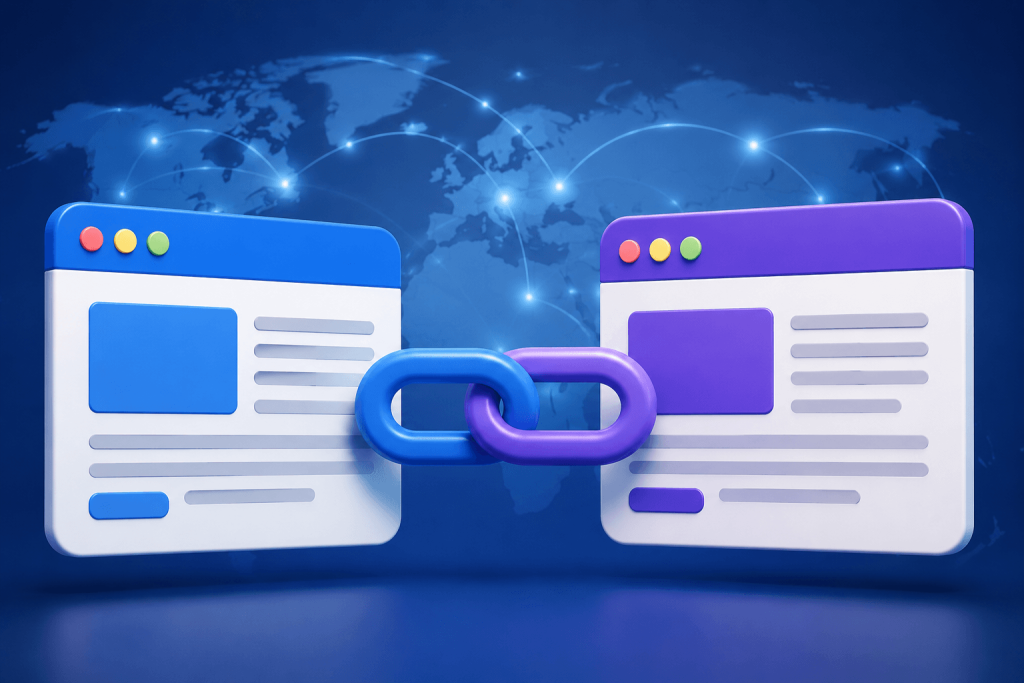
An External Link is a hyperlink that connects one website to a different domain. If another website links to your pages, it is an external link pointing to your site. Likewise, when you link from your website to another trusted website, that is also considered an external link. These links are important because they improve user experience, help search engines understand your content, and contribute to your site’s authority and credibility.
For example:
<a href="https://www.example.com/">Link Anchor Text</a>
The clickable text, known as anchor text, should clearly describe the destination page instead of using generic phrases like “click here.”
What Are External Links?
An external link is any hyperlink that points from one domain to another. Unlike internal links, which connect pages within the same website, external links connect users to content hosted on different websites.
External links work in two ways:
- Inbound external links (backlinks): Another website links to your content.
- Outbound external links: Your website links to another website.
Both types serve different purposes but are valuable for SEO and user experience when used appropriately.
Why External Links Matter
External links play a significant role in both search engine optimization and usability.
Improve User Experience
Users often need additional information beyond what’s available on a single page. Linking to trustworthy resources helps them learn more without having to search on their own, creating a better browsing experience.
Help Search Engines Understand Content
Search engines use external links to understand your page’s topic, relevance, and relationship with other websites. Links between related websites help establish topical authority.
Build Trust and Credibility
Linking to reputable sources demonstrates that your content is well-researched and supported by reliable information. Similarly, earning backlinks from authoritative websites signals that your content deserves recognition.
Drive Referral Traffic
Quality external links can also bring visitors directly from other websites, increasing your exposure and attracting users already interested in your topic.
Internal Links vs. External Links
Although both are essential for SEO, they serve different purposes.
| Internal Links | External Links |
|---|---|
| Connect pages within the same website | Connect to a different website |
| Improve site navigation | Provide additional resources |
| Help distribute authority across your website | Build credibility and authority |
| Keep visitors engaged on your site | Expand the user’s knowledge |
A balanced SEO strategy uses both internal and external linking effectively.
How Search Engines Evaluate External Links
Search engines don’t treat every link equally. They evaluate multiple signals before assigning value to an external link.
Some of the most important factors include:
- Authority and trustworthiness of the linking domain
- Relevance between the linking page and the destination page
- Quality of the linking content
- Descriptive anchor text
- Number of unique domains linking to the page
- Diversity of anchor text
- Overall link profile and ownership relationship
The more authoritative and relevant the linking website, the more valuable the backlink becomes.
Why External Links Influence Rankings
Search engines have long considered links as recommendations between websites.
Popularity
Links act as public endorsements. Pages receiving backlinks from numerous high-quality websites are generally viewed as more authoritative and trustworthy.
Unlike website traffic, which is difficult for search engines to measure accurately, links are publicly accessible and much easier to evaluate.
Relevance
Anchor text and surrounding content provide strong contextual signals. When multiple websites link to a page using similar descriptive terms, search engines gain confidence about the page’s topic.
This helps establish topical authority and improves rankings for relevant searches.
SEO Best Practices for External Link Building
1. Use Descriptive Anchor Text
Anchor text should clearly explain what users will find after clicking the link.
Good examples:
- Beginner’s Guide to SEO
- Website Security Checklist
- Google Search Console Documentation
Avoid vague phrases such as:
- Click here
- Learn more
- Read this
Descriptive anchor text improves usability and gives search engines additional context.
2. Keep Anchor Text Natural
Avoid repeating the exact keyword for every backlink.
Instead, use a variety of anchor texts, including:
- Brand names
- Partial keywords
- Natural phrases
- URLs when appropriate
A diverse anchor text profile appears more natural and reduces the risk of spam signals.
3. Link Only to Trusted Sources
When linking externally, choose websites that are:
- Authoritative
- Relevant to your topic
- Accurate and regularly updated
Avoid linking to spammy or low-quality websites, as they can negatively affect user trust.
4. Earn High-Quality Backlinks
The strongest SEO benefit comes from earning backlinks rather than creating them.
Effective methods include:
- Publishing original research
- Creating detailed guides
- Producing useful tools or resources
- Writing shareable content
- Building relationships within your industry
Quality consistently outweighs quantity.
5. Focus on Relevance
A backlink from a relevant website is usually more valuable than dozens of unrelated links.
For example:
- A travel blog linking to another travel website is highly relevant.
- A technology website linking to a travel guide carries less topical relevance.
Search engines increasingly prioritize contextual relevance.
6. Use Nofollow When Appropriate
Sometimes you may want to link to another website without passing ranking signals.
Use the nofollow attribute for:
- Sponsored content
- Paid links
- User-generated content
- Websites you don’t fully endorse
This helps maintain compliance with search engine guidelines.
Common External Linking Mistakes
Avoid these common SEO mistakes:
- Buying backlinks
- Excessive link exchanges
- Using identical keyword-rich anchor text repeatedly
- Linking to low-quality or spam websites
- Ignoring broken external links
- Adding links solely for SEO rather than user value
Search engines reward natural, helpful linking practices over manipulative tactics.
Google’s View on External Links
Google’s original PageRank algorithm revolutionized search by treating hyperlinks as votes of confidence. Although today’s ranking algorithms are much more advanced, backlinks remain one of the strongest indicators of authority.
Google now evaluates not only the number of links but also their quality, relevance, trustworthiness, and natural acquisition patterns.
Rather than chasing as many backlinks as possible, website owners should focus on creating content that naturally attracts links from reputable sources.
Conclusion
A well-planned External Link strategy benefits both users and search engines. Linking to trustworthy resources improves content quality, while earning backlinks from authoritative websites strengthens your site’s credibility and search visibility. By focusing on relevance, descriptive anchor text, high-quality sources, and natural link building, you can build long-term authority and improve your overall SEO performance.