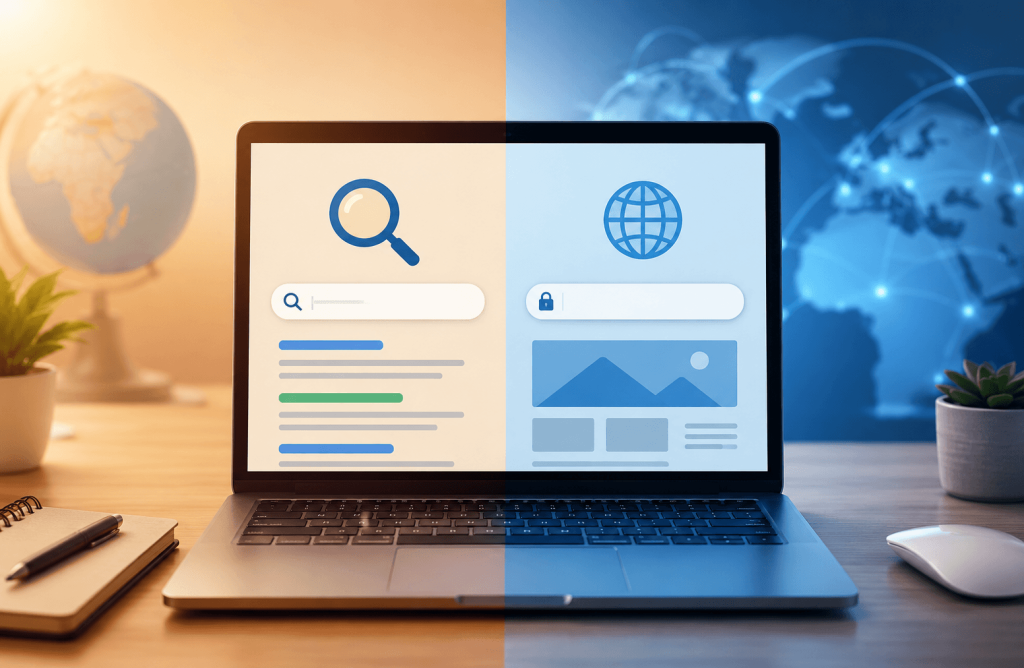
Every day, millions of people open their browser to look for information online. Whether you need to visit a familiar website or research a new topic, your browser gives you two simple options—Search Google or Type a URL. While both methods help you reach your destination, they serve different purposes and knowing when to use each can save time and improve your browsing experience.
In this guide, we’ll explain what these options mean, how Google’s Omnibox works, the differences between searching and typing a web address, and when each method is the better choice.
What Does “Search Google or Type a URL” Mean?
When you open a new tab in Google Chrome, you’ll notice the text “Search Google or Type a URL” inside the address bar. This feature appears in Chrome’s Omnibox, which combines the traditional address bar and search bar into a single field.
The Omnibox allows you to:
- Search the web using keywords or phrases.
- Enter a website address (URL) to visit a specific page directly.
Instead of maintaining separate search and address bars, Chrome lets you perform both actions from one place, making browsing faster and more convenient.
Search Google or Type a URL: Understanding the Difference
Although both options help you reach information online, they work differently and are designed for different situations.
Search Google
If you don’t know the exact website you need, simply type a keyword or question into the Omnibox and press Enter. Google searches its index and displays the most relevant pages related to your query.
This option is ideal when:
- You’re researching a topic.
- You want to compare multiple sources.
- You don’t know which website has the information you need.
- You’re looking for new websites or resources.
For example, searching “best places to visit in Kerala” will return travel blogs, official tourism websites, videos, and maps.
Type a URL
Typing a URL means entering the web address of a website directly into the browser.
For example:
- www.wikipedia.org
- www.amazon.in
- www.gmail.com
This method takes you directly to the website without displaying search results.
It’s best when:
- You already know the website you want.
- You visit the site regularly.
- You’re accessing secure portals, online banking, or work dashboards.
- You want to avoid unnecessary search results.
Even entering a partial domain often works because modern browsers automatically complete commonly visited websites.
What Is the Omnibox?
The Omnibox is Chrome’s smart address bar that combines search and navigation into a single input field.
As you type, Chrome automatically provides:
- Search suggestions
- Frequently visited websites
- Browsing history
- Bookmarks
- Autocomplete recommendations
This makes finding websites much faster without typing complete URLs every time.
Omnibox Shortcut
One of Chrome’s most useful keyboard shortcuts is:
Ctrl + L (Windows)
or
Cmd + L (Mac)
This instantly highlights the address bar so you can begin typing without touching your mouse.
How It Improves Your Browsing Experience
Modern browsers are designed to make navigation simple and efficient.
Instead of opening Google first and then entering a website, you can type everything directly into the Omnibox.
For example, you can:
- Search for information.
- Open websites instantly.
- Find bookmarked pages.
- Access browsing history.
- Perform quick calculations.
- Search specific websites using advanced operators.
A particularly useful technique is Google’s search operators.
For example:
site:gov filetype:pdf climate report
This searches only government websites for PDF documents related to climate reports, saving significant research time.
Using browser features effectively helps reduce the number of unnecessary clicks while producing more relevant search results.
When Should You Search Instead of Typing a URL?
Searching is the better option whenever you’re exploring information rather than visiting a known website.
Choose Google Search if:
- You need answers to questions.
- You’re researching a subject.
- You want multiple opinions.
- You’re comparing products or services.
- You don’t remember a website’s address.
Google indexes billions of web pages, making it easier to discover new resources you may never have found otherwise.
When Should You Type a URL?
Directly entering a website address is the fastest option when you already know your destination.
Typing a URL works well for:
- Frequently visited websites
- Email services
- Banking websites
- Company portals
- Educational platforms
- Government services
Since you skip Google’s search results entirely, you reach the website immediately.
This also reduces the risk of accidentally clicking an unrelated search result.
Advantages of Google Search
Google remains the world’s most popular search engine for several reasons.
Some major benefits include:
- Access to billions of indexed pages.
- Quick answers to questions.
- Image, video, news, and map searches.
- Advanced search filters.
- Discovery of new websites.
- Personalized recommendations based on search intent.
If your goal is learning, researching, or comparing information, searching is usually the best choice.
Advantages of Typing a URL
Direct navigation also has several benefits.
These include:
- Faster access to known websites.
- No need to browse search results.
- Fewer distractions.
- Better for secure logins.
- Convenient for regularly visited websites.
If you’re opening the same website every day, typing its address—or letting Chrome autocomplete it—is usually the quickest approach.
Finding the Right Balance
Neither method is universally better.
The right choice depends on what you’re trying to accomplish.
Use Google Search when you’re exploring new topics or looking for information from multiple sources.
Use a URL when you’re visiting a website you already know and trust.
Most internet users naturally switch between both methods throughout the day depending on their needs.
Conclusion
There isn’t a single “correct” choice between searching and typing a website address. Both options have unique advantages that make browsing easier in different situations.
If you’re researching, comparing information, or discovering new websites, Google Search offers flexibility and comprehensive results. If you already know where you want to go, entering the web address provides the quickest route with fewer distractions.
Understanding when to Search Google or Type a URL allows you to browse more efficiently, save time, and make better use of your browser’s built-in features.
Read Also: